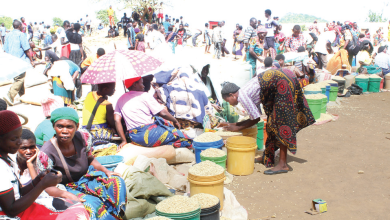
Service providers have begun passing the cost of new taxes onto consumers, pushing up prices of everyday goods and services and squeezing thousands of Malawians as the year begins.
The tax changes took effect on January 1 2026 after President Peter Mutharika assented to the Taxation Amendment Bill and the Value Added Tax (VAT) Amendment Bill, alongside other Bills.
The changes raise the zero Pay As You Earn (Paye) threshold from K150 000 to K170 000, but also introduces higher marginal rates: 30 percent for incomes from K170 000 to K1.57 million, 35 percent for incomes up to K10 million and 40 percent for earnings above K10 million.
VAT has increased from 16.5 to 17.5 percent.
The Malawi Revenue Authority (MRA) instructed VAT-registered operators to apply the new rate immediately.

Several service providers, including mobile network operators, have since notified customers of price adjustments.
A notice from TNM plc reads: “Effective 1 January 2026, prices of all TNM products and services will be adjusted following the change of VAT to 17.5 percent and introduction of a 0.05 percent levy on e-money transfers greater than K100 000.”
The price adjustments come at a time Centre for Social Concern (CfSC) data shows that the cost of living increased by eight percent in November 2025 from K871 175 to K938 841.
Rising food taxes and increased VAT was attributed to the cost of living increase.
Our spot-checks on Thursday and Friday in both retail shops and local hawkers that are VAT registered found that some basic necessities like sugar, salt, cooking oil, soap and sanitary pads have been adjusted with at least between K1 000 and K2 500.
Some retail shops were, however, as of Friday still selling some of their merchandise at discounted prices as part of their promotions for the festive period.
But some insiders told us that once the promotion periods end—most of which end on January 5—prices will rise.
In an interview on Friday, Consumers Association of Malawi (Cama) executive director John Kapito said the tax adjustments will be detrimental to Malawians.
“These taxes have been adjusted at a time when consumers are experiencing the highest cost of living and the impact will be devastating.
“Unfortunately, the administration in VAT tax collection is one of the worst where the biggest beneficiaries are the same traders who for a long time have cheated and taken advantage of the tax system by their failure to issue receipts and this is a tax that raises prices without adding value to government revenue collection,” he said.
Kapito said it is disturbing that such a tax has also been extended to exempted products, hurting consumers more.
He said: “VAT benefits the traders and tax collectors; they create a syndicate where VAT doesn’t reach MRA and what the government collects is nothing compared to what is shared through the syndicate.”
CfSC economic governance officer Agness Nyirongo in a separate interview on Friday said in the short-term, the situation will erode consumers’ purchasing power, particularly for low and middle-income households.
She said this will be the scenario considering that low and middle-income households often allocate a large share of their income to basic necessities such as food, transport and utilities.
“As prices rise, many consumers are forced to cut back on consumption, delay essential purchases or shift to cheaper and often low-quality alternatives,” she said.
“This not only increases household financial stress, but may also weaken overall demand in the economy, adversely affecting small businesses and informal traders.”
In the long-term, Nyirongo said sustained price increases risk deepening the cost of living crisis and widening inequality, especially if incomes do not align with rising costs.
Nyirongo further said there is a danger that continuous price hikes could entrench inflation expectations, making it more difficult to stabilise and restore consumer confidence.
The sweeping tax reforms were introduced during the 2025/26 Mid-Year Budget Review.
Minister of Finance, Economic Planning and Decentralisation Joseph Mwanamvekha told Parliament that the taxes aim at cushioning low-income earners.
Mwanamvekha defended the taxes, saying they were adopted after careful consideration, stressing that those with a higher ability to pay should contribute more towards rebuilding Malawi’s economy.
Malawi’s economy has in the past five years worsened amid a continuous rise in inflation.
In 2019 when the Malawi Congress Party (MCP) took over government, inflation was at 9.4 percent and at the time it was being booted out of power in September 2025, inflation was at 28.7 percent.
As of November 2025, two months after the Democratic Progressive Party (DPP) took over government, inflation was at 27.9 percent, according to National Statistical Office (NSO) data.